Nothing new to move into
- Claude
- ChatGPT
- Cursor
- Slack
- The ako web app
- git, for engineers
The problem
Your agents answer from pages nobody stands behind.
A stale page now acts
It used to be untidy. Now an agent quotes it, promises from it and decides on it.
Nobody owns it
Keeping a page true is nobody's job, so it quietly stops being true.
Smarter search won't fix it
A better reader of the wrong page is a faster way to be wrong.
Of everything your agents can read right now, how much would you personally stand behind?
Your people were never meant to be the database.
Right now your best people spend their days being the company's memory: answering the same questions, rebuilding old decisions, checking whether a rule is real or folklore.
Take that away and what's left is the actual job: judgement, taste, decisions.
For teams already keeping knowledge in git
Git brains lock out most of the company, and let anyone inside write.
A git brain today needs
- A GitHub seat, which most companies ration
- Claude Code or a terminal to work in it
- Local scripts to keep copies in sync
- Anyone with access writes straight to the main copy
With ako, anyone can
- Sign in on the web, in Slack or in their AI tool
- Skip the GitHub account, terminal and scripts
- Work in a brain that's hosted and kept in sync
- Write within their role; the rest waits for approval
Still markdown in git underneath. Engineers can keep using git, and every push is checked against the same roles.
How it works
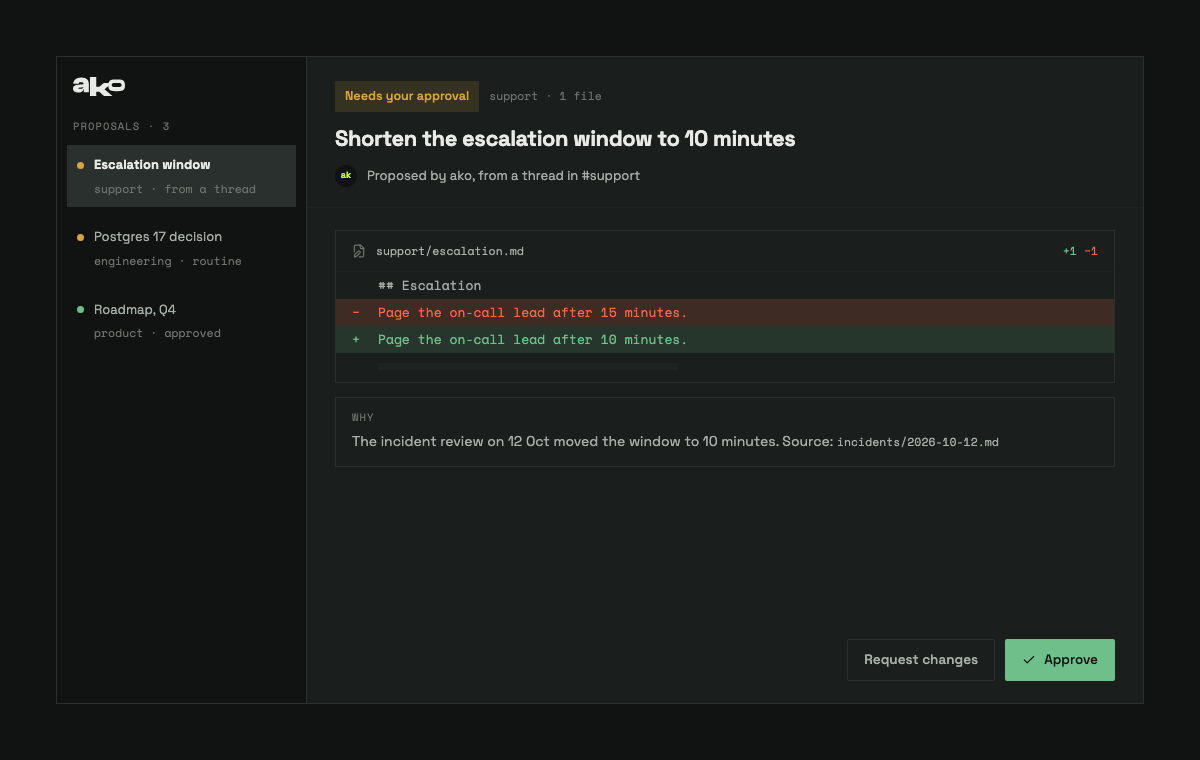
Every change reaches the right person, whoever makes it.
- A person, the assistant or a routine makes a change
- ako checks it against their role and your ground truth
- Saved and recorded, or sent to the owner for a yes
- Your team and every tool read the same version
- Roles and folders decide what needs approval, so most saves go straight in.
- A change that waits shows what changed, where it came from and why.
- Approvals are always a person's. An agent never approves.
Anywhere you work
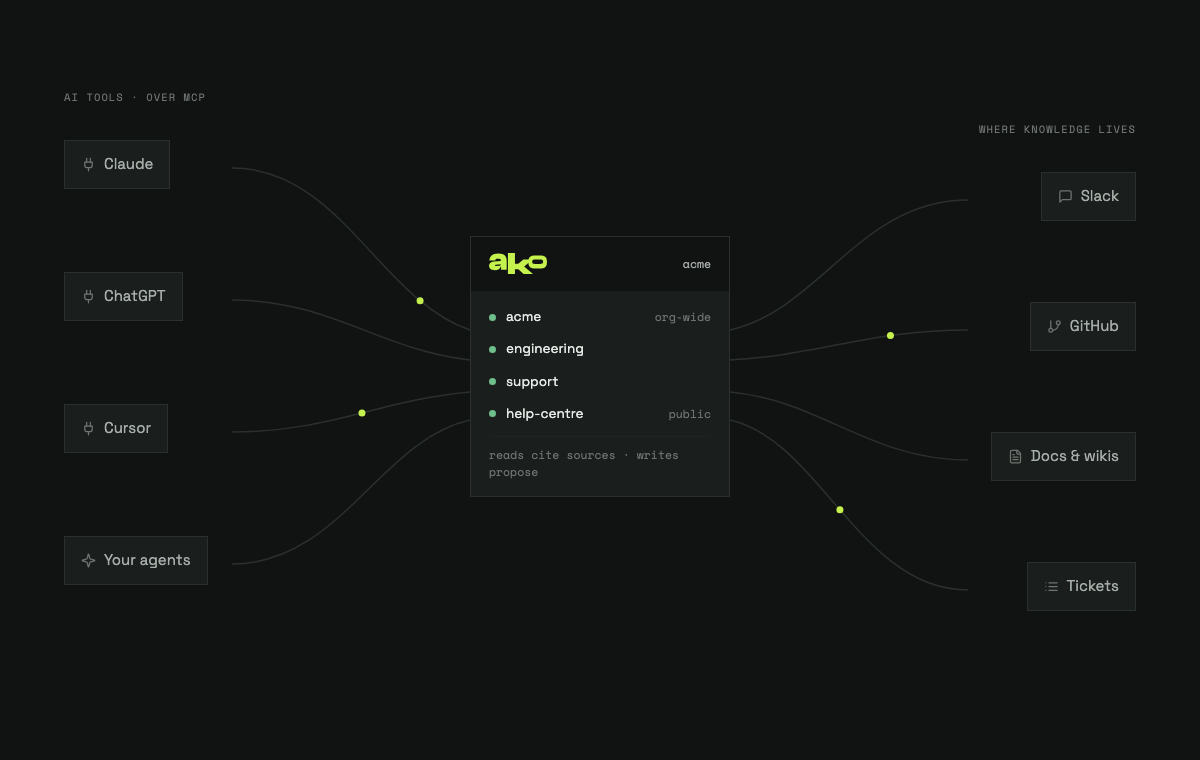
Work in ako, or in Claude, ChatGPT and any AI tool you use now.
The same memory in ako's own chat, or through our MCP server in the assistants your team already uses. Same answers, same sources, same rules.
- Answers show which page they read and who approved it.
- Each person sees only what they may read.
- Assistants write under the same rules as the person using them.
In the flow
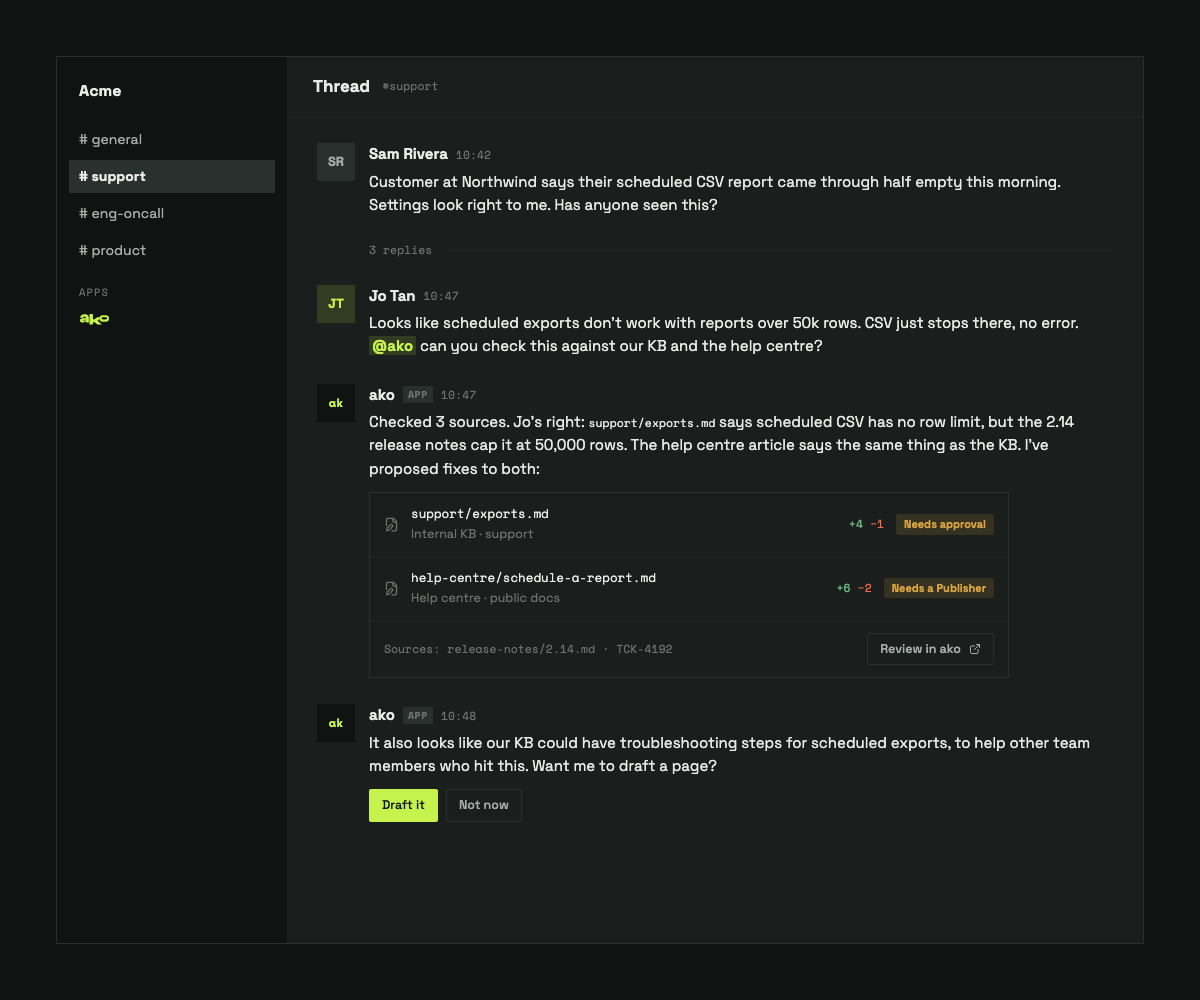
Ask in the thread. Fix the source.
Tag ako where the question comes up. It checks your knowledge and your help centre, says what's wrong, and proposes the fix to both.
- Answers in Slack threads, with sources.
- Offers to write the page that was missing.
- Every fix is recorded, and protected pages wait for a yes.
Routines
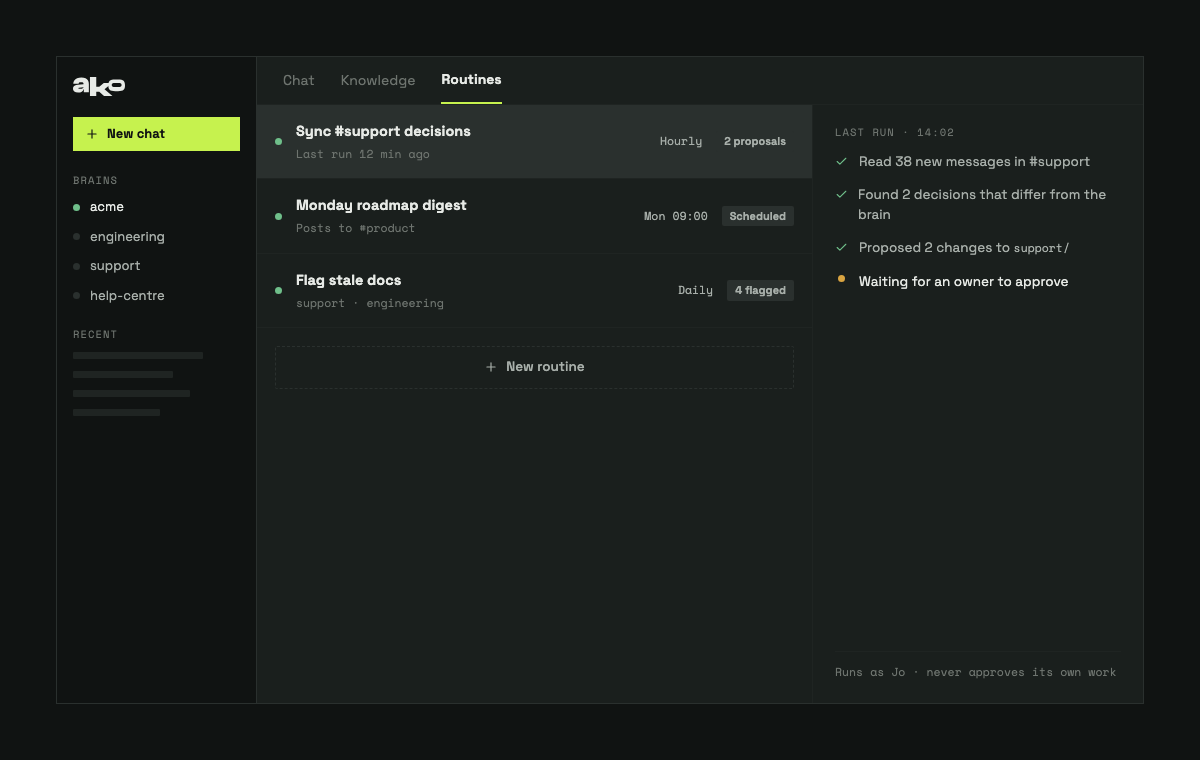
It keeps itself current, with an owner.
A routine runs on a schedule you set, reads the places your knowledge changes, like Linear and Slack, and updates what's drifted. Anything protected waits for its owner.
- Acts as its owner, and never approves its own work.
- Reads connected tools, like Linear, without writing to them.
- Try any routine as a shadow run first.
Built with itself
We build ako with ako.
- Our roadmap, decisions and ground truth live in ako brains.
- The AI tools that help build ako read and write them through ako, under the same rules as yours.
- Our public docs are written in a brain and published from it, at docs.useako.com.
AI-native help centres
Publish your help centre from the same memory.
Fixes your team approves reach customers once a Publisher publishes them, for people and the AI that reads your docs.
Our own docs run on it: docs.useako.com
Yours to keep
Plain markdown in git. Take it with you.
Clone it any time and switch models whenever you like. If ako disappeared, you'd keep every page and lose only the automation.
not a wikinot a vector storenot a data warehouse- a memory your people approve
What it costs you
Approval is a real step, and someone has to own each piece of ground truth.
You trade a little speed when writing for being able to trust everything downstream. If you want agents that move fast and answer from whatever they find, you don't need us.
Questions we hear
Why isn't Copilot this?
Models change. What your company knows, and who approved it, should stay put when they do.
What happens to our knowledge if you disappear?
It's markdown in git. You'd keep every page and lose only the automation.
Who works the approval queue?
The people who own each area. Roles and folders decide what needs them, so most saves go straight in, recorded.
Does it replace Notion or Confluence?
It doesn't have to. Bring your knowledge in, and keep working in the tools you use today.
Is it secure?
Roles are checked on the server on every surface, and every change is recorded. You can sign in with Google; single sign-on isn't built yet.
Which AI tools work with it?
Claude, ChatGPT and Cursor over MCP, plus ako's own chat in the web app and Slack.
Para-knowledge becomes knowledge one way: a person stands behind it.
Company knowledge your AI agents and team can stand on.
We're inviting new teams now. We'll only email you about your invite.
You're on the list.
Five quick questions help us decide who to invite first. All optional.
You're in.
We'll email you when your invite is ready.